The non-developer SDLC: nothing changes, and everything is changing
People who don't write code now build and share software. The non-developer SDLC is how that software meets the controls you already answer to, by a different route.
I have spent most of my career on the DevOps side of software. I watched DevOps go from an idea we had to sell to engineers, to the team every release waited on.
That shift felt big. This one is bigger. The people joining the software lifecycle now don’t write code, and the apps they build already hold your company’s data.
The circle kept widening
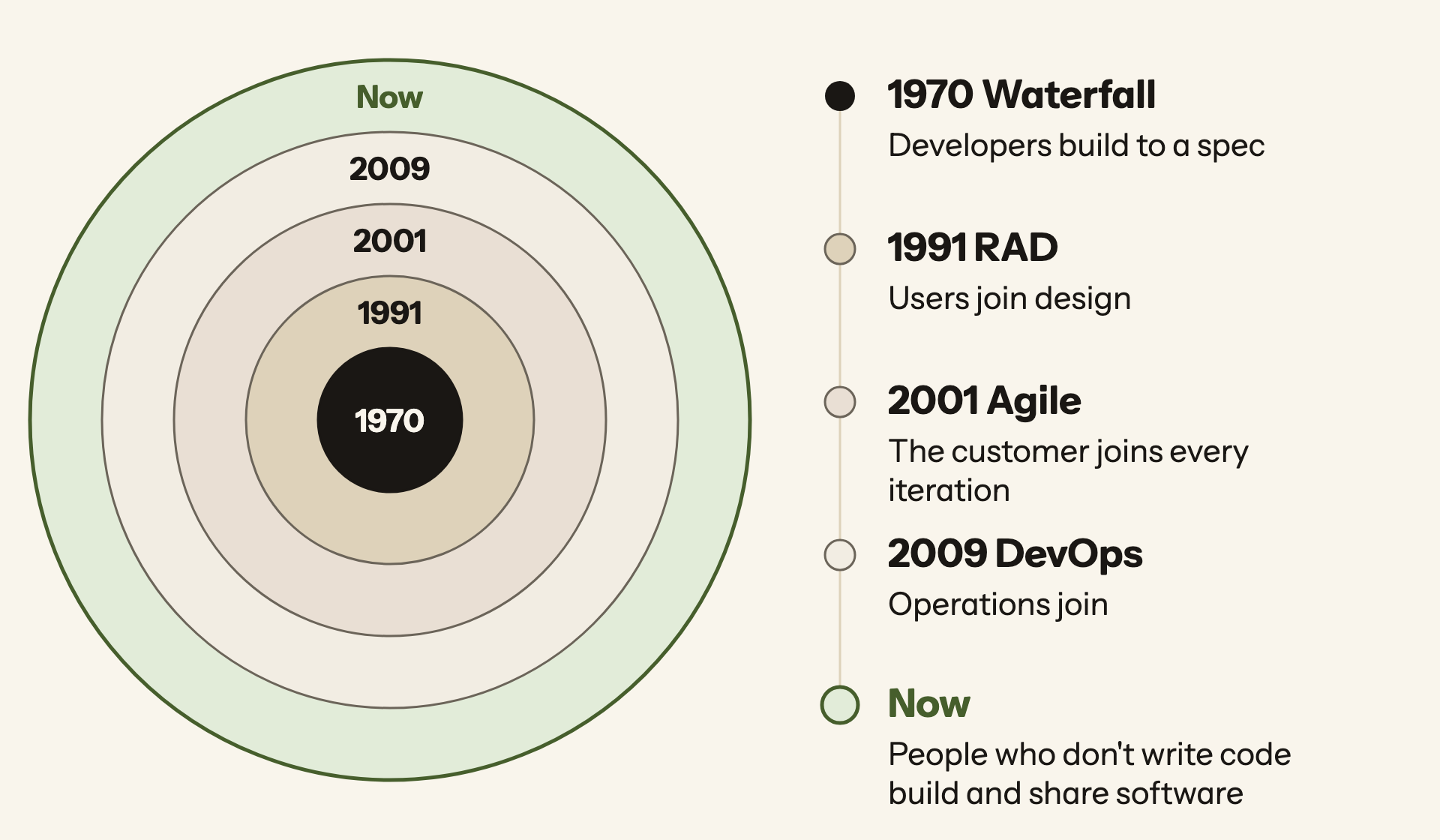
Each SDLC model decided who gets to be in the loop.
Most people trace the waterfall to Winston Royce’s 1970 paper, and the paper already argued against running it as a straight line1. The industry did anyway. Developers built to a spec and everyone else waited at the end.
Then the circle widened. Rapid application development brought users into design. Agile brought the customer into every iteration2. DevOps brought operations into the team. “You build it, you run it” made running the software part of the developer’s job3.
DevOps turned into a bottleneck when it became a team you filed tickets with. It stopped being one when it became a platform teams could use themselves.
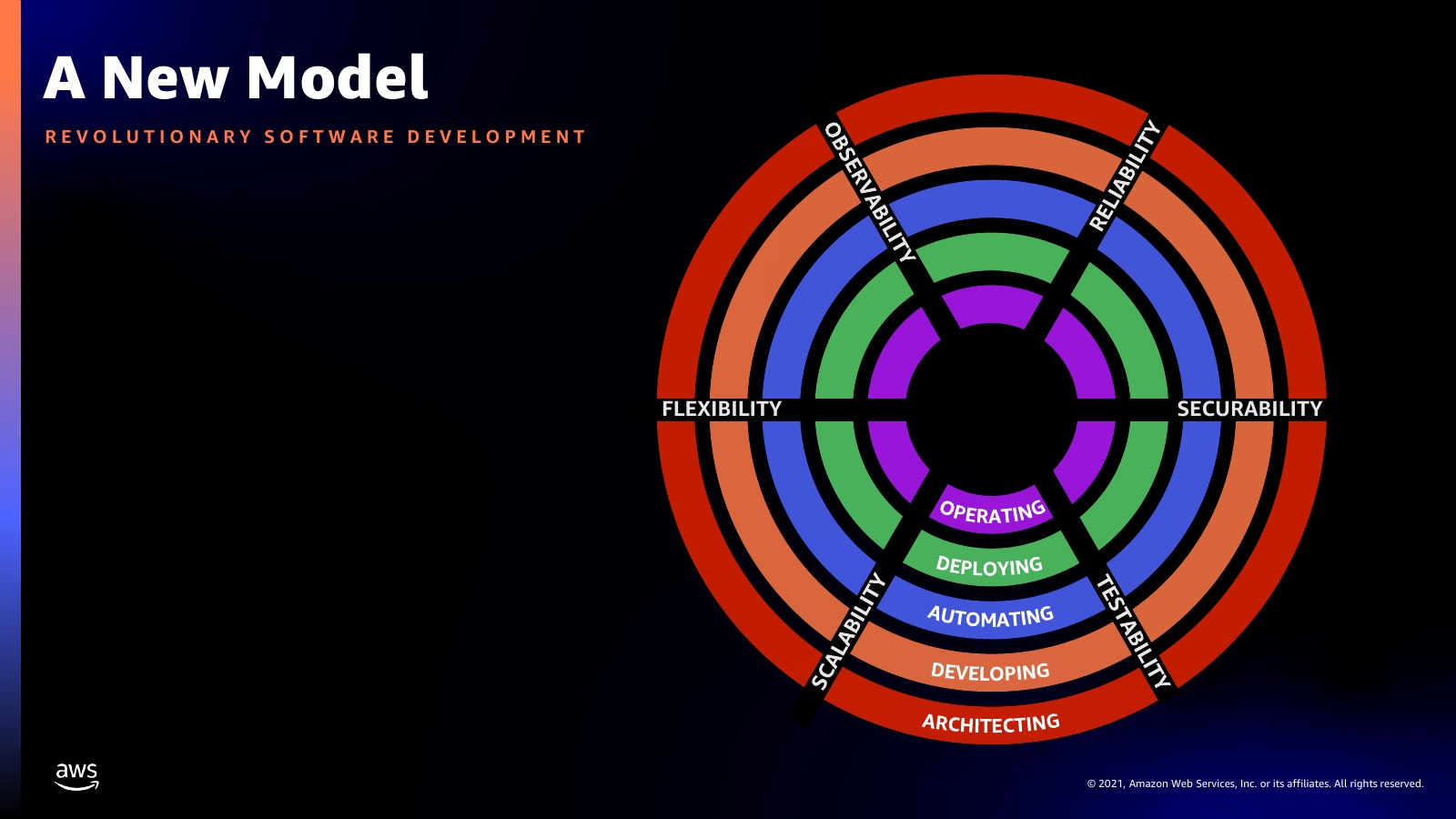
At re:Invent 2021, Emily Freeman showed how DevOps bent the SDLC into an infinity loop, then replaced the loop with her revolution model. One slide is titled “There are no straight lines”4.
Every earlier newcomer learned the process. Users learned to write stories. Operations learned to read code. Developers learned to carry a pager.
The people joining now won’t learn the process. They open a chat, describe what they need and have a working app by the afternoon.
What worries IT and security
An AI agent deleted a live production database during a code freeze, and the person using it was an experienced founder5. Researchers found that anyone could get into apps on one popular builder by registering with nothing more than the app’s id6. A security firm scanned 5,600 public apps built this way and found more than 400 exposed secrets. It was one snapshot, and the firm says its sample leaned toward a single builder7.
Every new way of building software ships bugs. The harder problem is that you can’t see what is running.
In Retool’s 2026 survey of technology leaders, 93% said they were at least somewhat concerned about AI-built tools running in production. Only 5% were very confident they could see all of them8. One of them said: “When anyone can ship a tool in an afternoon, nobody signs up to maintain it.”
Two answers that don’t work
Most organizations try one of two things.
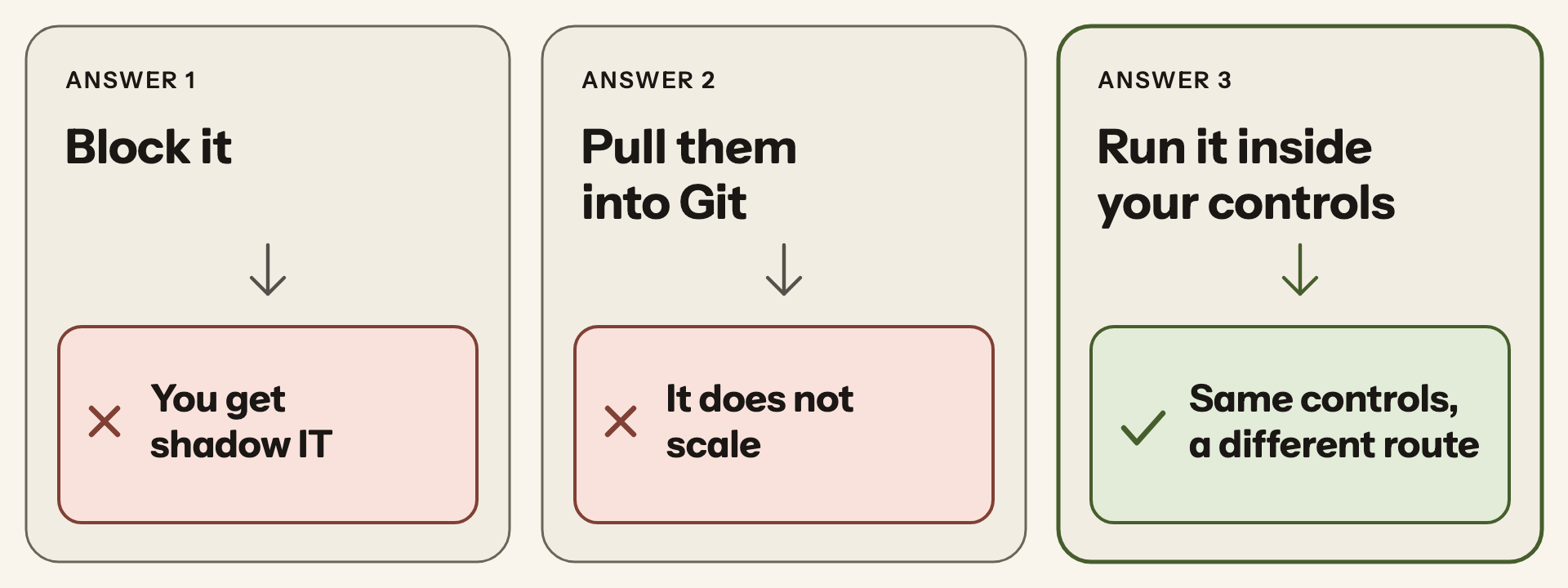
Block it. The tools are a browser tab away, so the apps get built anyway and run where you can’t see them. That is shadow IT.
Pull non-developers into the developer SDLC. Give the finance analyst a repository, a pull request and a pipeline. It does not scale, and nobody on either side wants it.
Nothing changes, and everything is changing
The third answer is to keep the controls and move where they live.
Nothing changes in what you answer to. You still need change approval, access reviews, an audit trail, rollback and offboarding. Your auditor will ask the same questions next year.
Everything changes in how you meet them. The builder will never open a pull request, so the control can’t live there. It has to live in the platform the app runs on.
The non-developer SDLC
I want to name it so a team can own it.
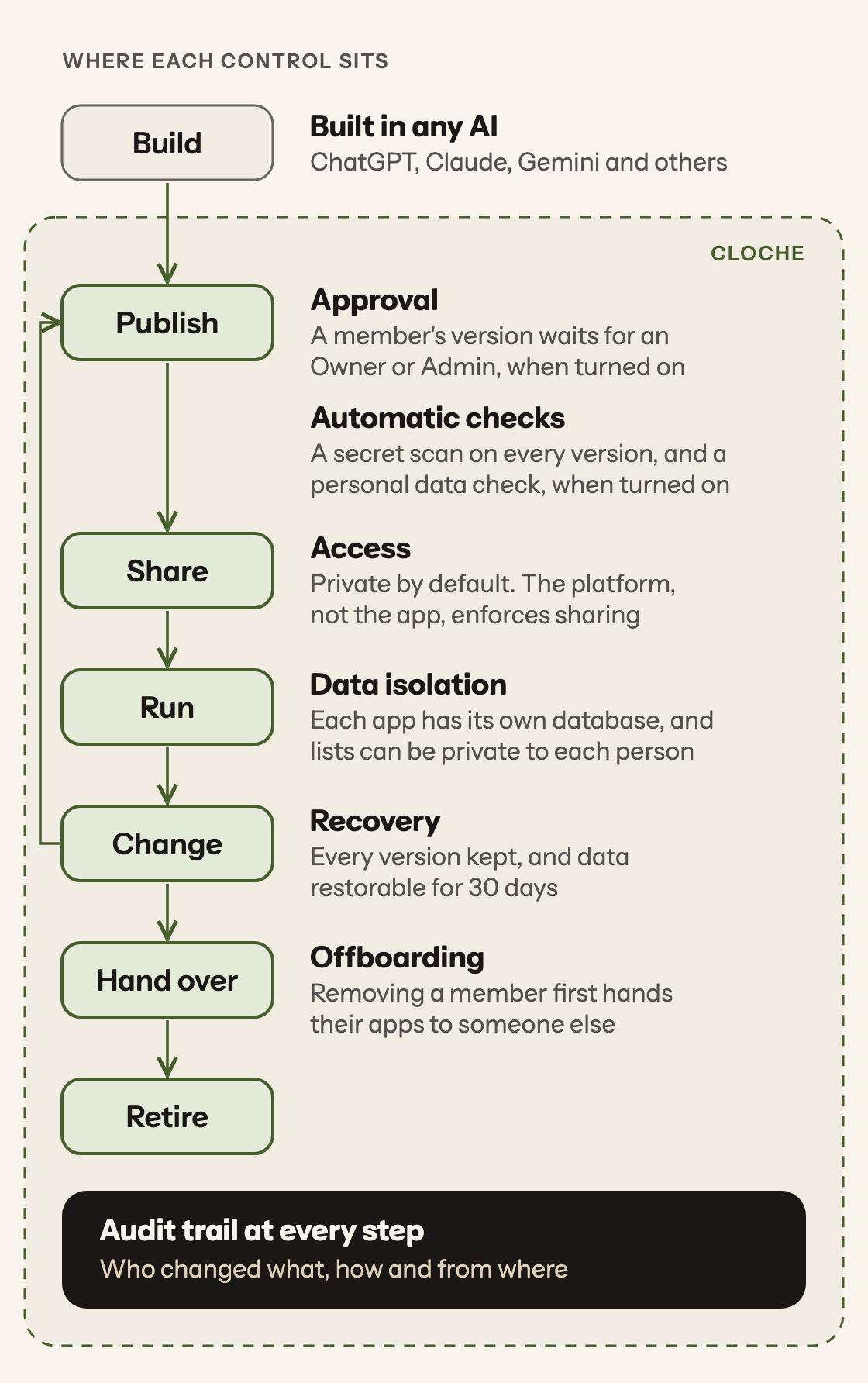
The non-developer SDLC is the lifecycle of software built by people who don’t write code, once it is shared with others or connected to company data. It runs from build to retire and meets the same controls as the developer SDLC by a different route.
It has seven stages: build, publish, share, run, change, hand over and retire. Testing happens at publish, before a version goes live. Each stage has one accountable owner, the person who built the app, until they hand it over.
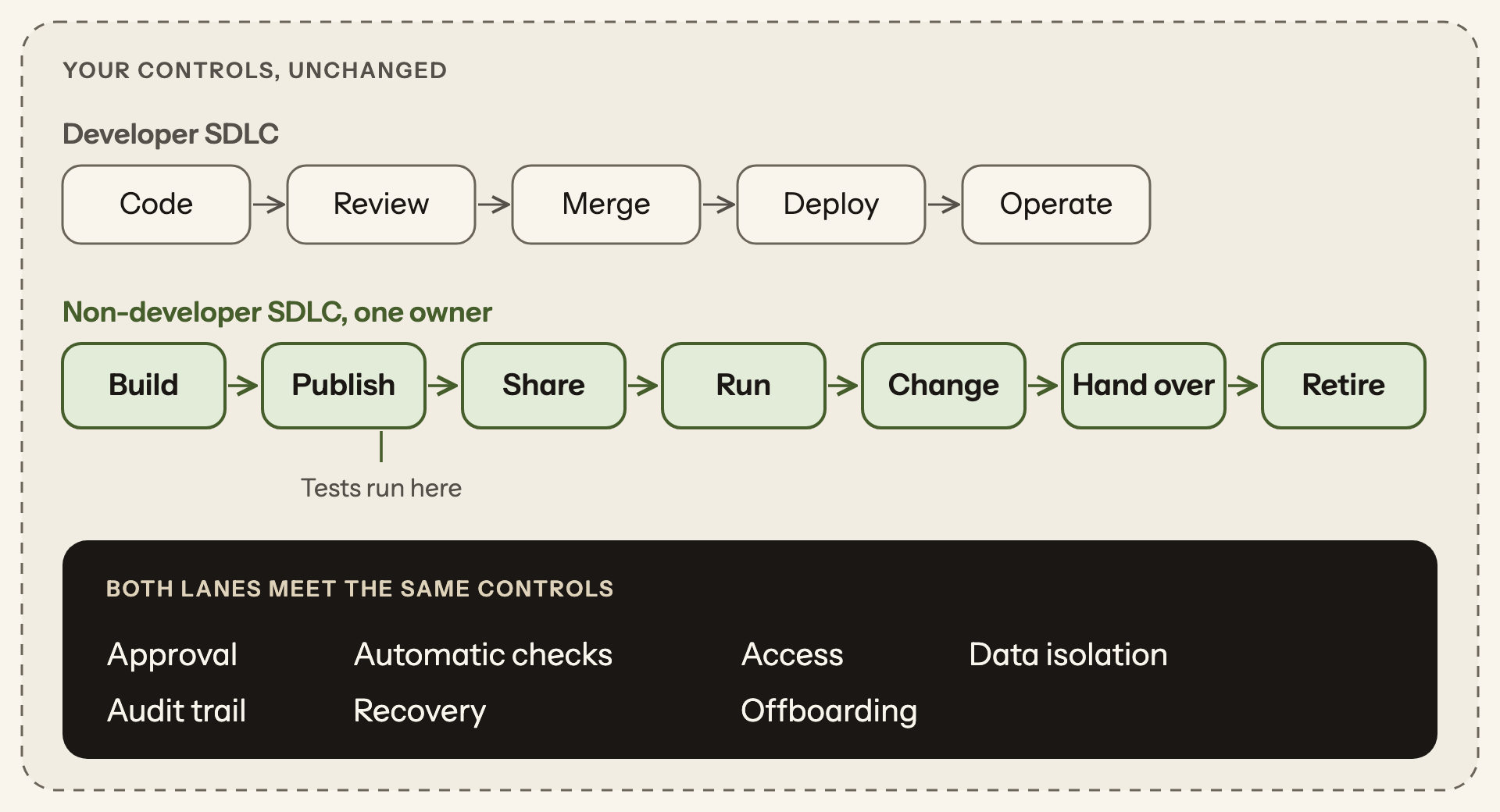
It does not replace your SDLC. It lives inside it. AI is not part of the definition. It is why there is so much of this software now, but a low-code tool counts the same way.
The full definition, with what counts and what doesn’t, is at cloche.dev/non-developer-sdlc. It is free to reuse with credit.
The controls, met by a different route
This is the table I would hand an auditor. The first three columns are the definition. The last is how we meet each control at Cloche.
| Control | Developer SDLC | What the platform must provide | As Cloche meets it |
|---|---|---|---|
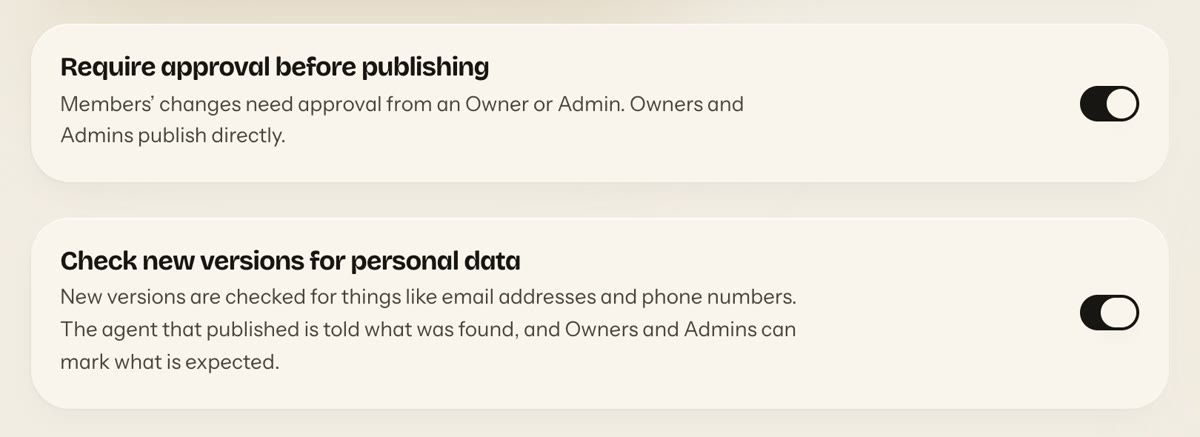
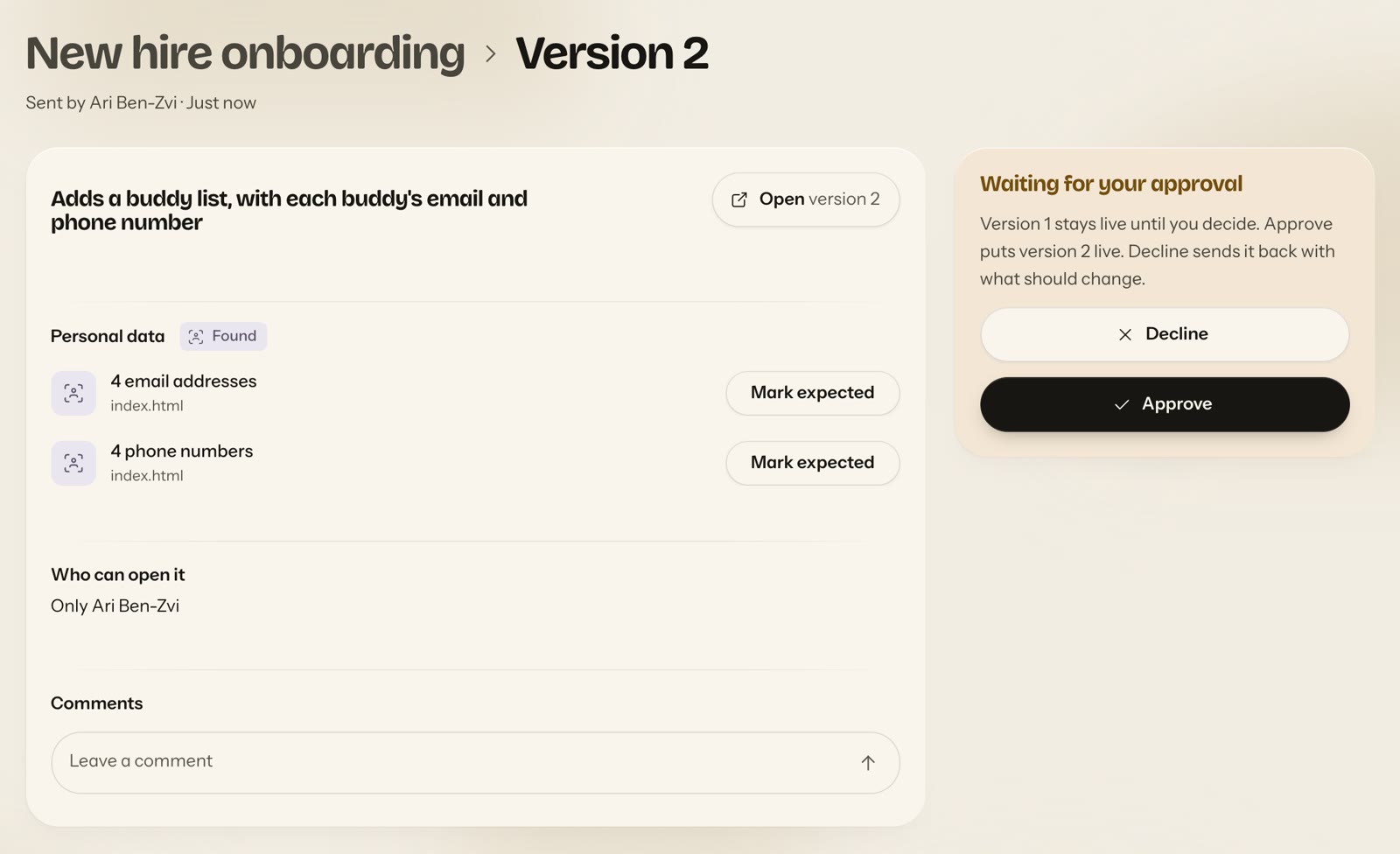
| Change approval | Pull request review, change ticket | An approval step before a version goes live | An Owner or Admin approves each version a member publishes, when the organization turns approval on |
| Code review | Peer review, static analysis | Automatic checks on every version | A secret scan on every publish, on unless an Owner turns it off, and a personal data check the organization can turn on |
| Separation of duties | The author cannot merge alone | The builder cannot approve their own release | A member’s version waits for an Owner or Admin when approval is on. An Owner’s or Admin’s own publish goes live without a second reviewer |
| Access control and review | Identity and access management, periodic review | Private by default, with access enforced outside the app | New apps are private, and the platform enforces sharing, not the app |
| Data isolation | Separate databases per service, least privilege | Each app’s data kept apart, with entries scoped per person when needed | Each app has its own database, and lists can be private to each person |
| Audit trail | Version control history, deploy logs | A record of who changed what, and when | A trail of who changed what, how and from where |
| Rollback and recovery | Revert and redeploy, backups | Every version kept, and data that can be restored | Cloche keeps every version, and data can be restored to any moment in the last 30 days |
| Offboarding | Reassign repositories and services | Apps that are handed over when their builder leaves | Removing a member first hands their apps to someone else |
Two of these controls are off by default. Approval and the personal data check stay off until an organization turns them on. I would rather say that here than have you find it later.
Who runs it
Security should not approve every app. That recreates the queue that made DevOps a bottleneck. Security sets the policy once, and the platform applies it to every version.
The platform team runs the non-developer SDLC as a product, the same way it runs the internal developer platform. My co-founder Nitzan calls this the shift down. Guardrails move into the platform, so builders don’t have to add them to each app. The non-developer SDLC is the lifecycle that platform runs. It starts on Day 2, when other people need to use what someone built.
Where Cloche fits
Cloche does not build apps. People build in ChatGPT, Claude, Gemini or whatever AI they already use. Cloche is where those apps run, and where the platform decides who sees what. It is one answer to the non-developer SDLC, and I would like to see more.
Tell me where it breaks
The definition is a first version, and I expect it to be wrong somewhere.
If a line does not hold in your organization, I would love to hear it. Write to me at pini@cloche.dev.

Sources
- Winston W. Royce, Managing the Development of Large Software Systems, opens in a new tab.
- Beck et al., Manifesto for Agile Software Development, opens in a new tab.
- Werner Vogels, interviewed by Jim Gray, A Conversation with Werner Vogels, opens in a new tab, ACM Queue, 2006.
- Emily Freeman, DevOps revolution (DOP208), AWS re:Invent 2021. Recording, opens in a new tab and slides, opens in a new tab.
- Fortune, AI coding tool Replit wiped a database and called it a catastrophic failure, opens in a new tab.
- Wiz, Critical vulnerability in Base44, opens in a new tab.
- Escape, How we discovered vulnerabilities in apps built with vibe coding, opens in a new tab.
- Retool, AI Governance Report 2026, opens in a new tab.